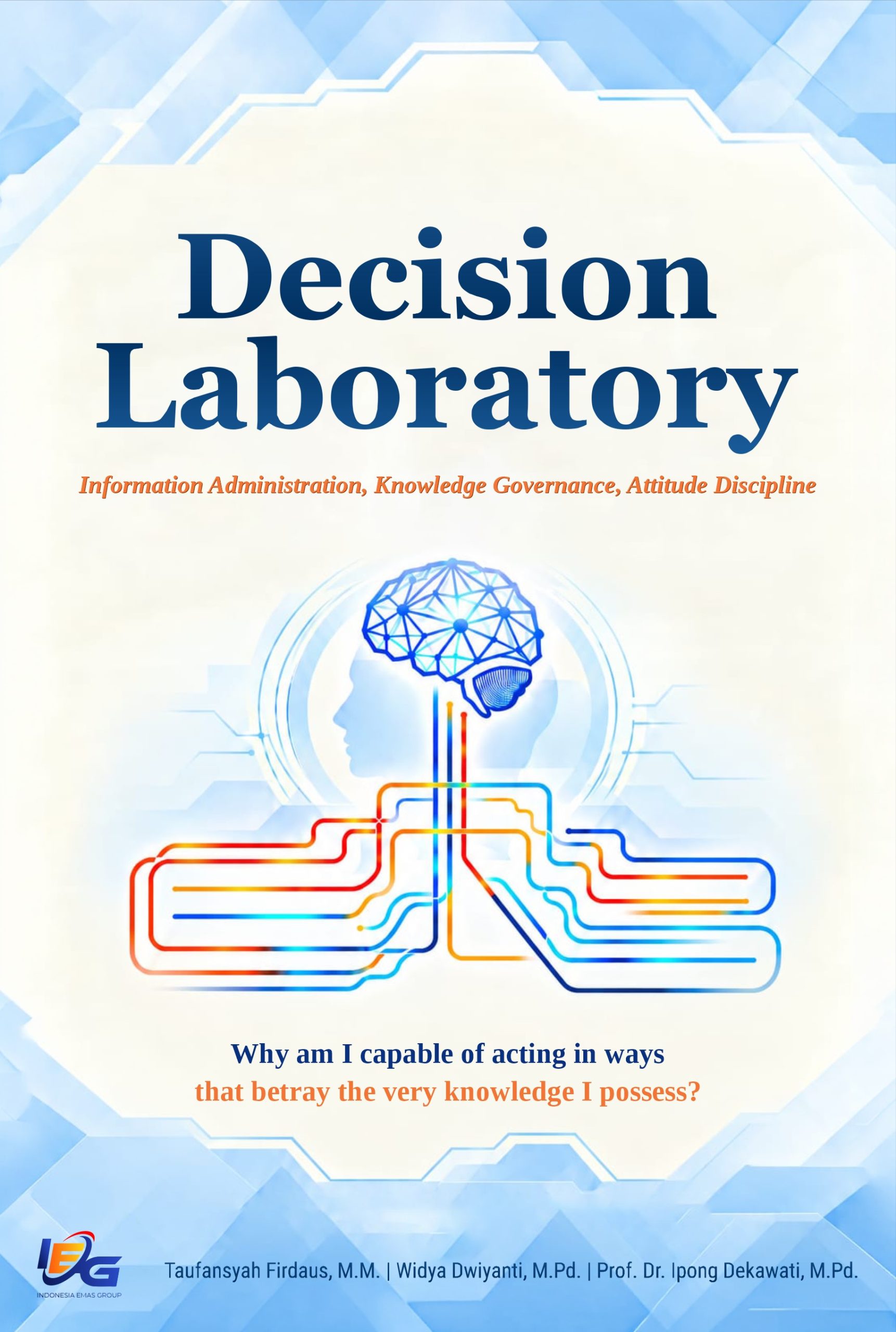

In organizations that move at ever-increasing speed, people are often required to make decisions amid an abundance of information, limited attention, competing interests, and consequences that are not always visible from the outset. Decision Laboratory begins with a fundamental question: how can an action truly be held accountable if the process that produced it is never examined?
This book invites readers to trace a chain that is often overlooked—from reality, information, knowledge, attitude, decision, action, and consequence, and onward to behavior, character, Role Accountability, and Reliability. Within this framework, a decision is not an isolated event. It is the point at which a person’s understanding of reality enters the world as action and begins to affect others.
Through three central pillars—Information Administration, Knowledge Governance, and Attitude Discipline—Decision Laboratory offers a conceptual architecture for understanding how individuals and organizations can develop a more disciplined relationship with reality. It examines how information loses context, how knowledge can harden into untested belief, and how ego, fear, interest, and self-justification can produce Epistemic Corruption before its consequences become visible in action.
The framework is further developed through concepts such as the Integrity Gap, Decision Collateral, Action-Behavior-Character Cycle, Action as Evidence of Reasoning, Leadership as Character Amplifier, and Role Accountability. Together, these concepts converge on a critical question: can a person remain a Reliable Role-Holder when incentives change, pressure intensifies, and no one is watching?
Decision Laboratory is not a recipe book promising procedural certainty, nor is it an experimental report or a validated measurement instrument. It is a conceptual architecture and reflective space for examining Reasoning Quality, Correctability, responsibility for consequences, and the character formed through repeated action.
Written for academics, practitioners, educators, leaders, human-resource professionals, and reflective readers, this book offers a way to understand organizations from the source of their actions: not only by what they achieve, but by how people understand, choose, act, learn, and ultimately become individuals and organizations worthy of trust.
Penulis : Taufansyah Firdaus, M.M. | Widya Dwiyanti, M.Pd. | Prof. Dr. Ipong Dekawati, M.Pd.
Jumlah Halaman : xiv + 590 hlm
Ukuran : 15,5 x 23 cm